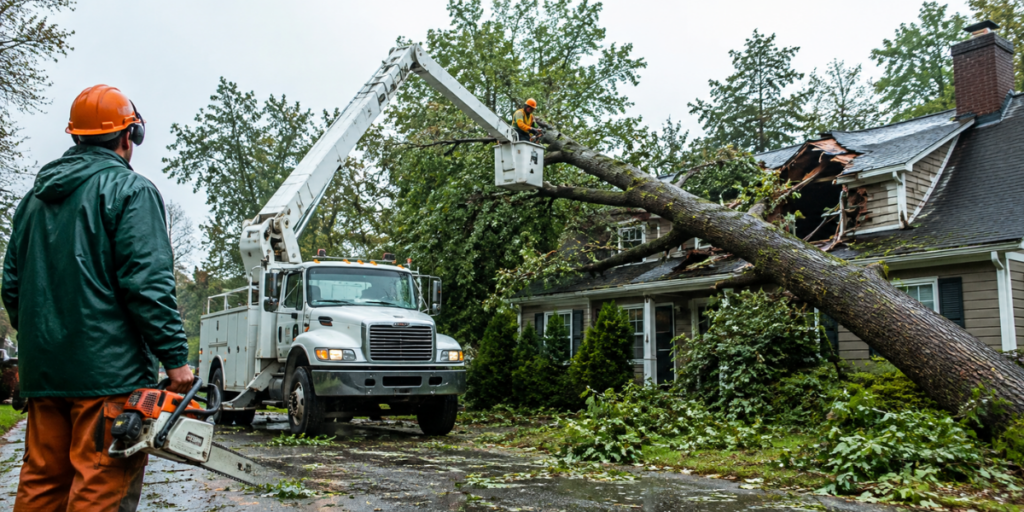
A homeowner wakes at 2 a.m. to a cracking sound and finds an oak limb resting on the roof. They do not open a browser and research the ten best arborists in the county. They grab a phone, type “emergency tree removal near me,” and call one of the first two results. That entire decision takes under ninety seconds.
Local SEO for emergency tree companies is not a marketing channel in 2026. It is the dispatch system. If your business does not appear in that ninety-second window (the Google map pack, the AI Overview, the answer ChatGPT gives when someone asks who to call), the job goes to a competitor who did. There is no second chance at an emergency lead. The tree only falls once.
Emergency Search Behavior Is Unlike Any Other Local Query
Most local searches allow deliberation. Someone shopping for a kitchen remodel compares five contractors over three weeks. Someone with a limb through their bedroom ceiling does not compare anything.
Emergency tree searches share three traits that make visibility unusually decisive:
- They are urgent. Intent-to-call is immediate, not researched. The searcher wants a phone number, not a portfolio.
- They are hyper-local. “Near me” is literal. A crew forty minutes away loses to a crew twelve minutes away, every time.
- They are weather-clustered. Demand does not arrive evenly. It arrives in twelve-hour surges after a storm, when every homeowner in three ZIP codes searches at once.
That last point is what makes ranking a business decision rather than a branding one. Your entire quarter’s emergency revenue may be decided across a handful of storm nights. Rankings cannot be bought on the night of the storm. They are earned in the quiet months before it.
What Changed in 2026: Search Now Answers Instead of Listing
For two decades, local SEO meant ranking a page or a map listing. In 2026, a growing share of searches never produce a list at all.
Google’s AI Overviews now sit above organic results for a large volume of service queries, summarizing an answer and naming a handful of businesses. Meanwhile, homeowners increasingly ask assistants directly: “Who can remove a fallen tree in Charlotte tonight?” ChatGPT, Gemini, Claude, and Perplexity return a short synthesized answer naming two or three providers.
This is the shift that Generative Engine Optimization (GEO) and AI Overview Optimization (AIO) address. The rules are different from classic SEO:
- Traditional SEO competes for a position in a list of ten links.
- GEO and AIO compete to be the source an AI model quotes when it composes an answer.
Being ranked #4 organically still earns clicks. Being unmentioned in an AI answer earns nothing, because there is no list for the user to scroll. In AI search, you are either cited or you are invisible. For emergency work, where the searcher accepts the first credible recommendation, that binary is brutal.
The Local SEO Foundation That Still Decides Who Gets Called
AI answer engines do not invent local recommendations. They assemble them from structured, corroborated signals across the web. Which means the fundamentals did not disappear. They became the raw material AI reads.
Google Business Profile is still the single highest-leverage asset. For emergency tree services, three fields do disproportionate work: accurate service-area boundaries, a genuinely correct 24/7 hours setting, and service listings that name the actual jobs (“emergency tree removal,” “storm damage cleanup,” “fallen limb removal,” “hazardous tree assessment”) rather than a generic “tree service.”
Service-area pages must be real pages, not templated clones. A page for each city or ZIP you genuinely cover, referencing local landmarks, common tree species, typical storm patterns, and response times from your yard. Thin duplicated pages with the city name swapped are filtered by Google and ignored by AI models, which cross-check claims against other sources.
Reviews function as third-party evidence. Language matters more than the star count. A review that says “storm took down a pine at 11 p.m., they had a crew out by midnight” is a corroborated fact an AI can repeat. Ten five-star reviews saying “great service” are not.
Consistency across directories is what makes you a verified entity. When your name, address, phone number, and hours match across Google, Bing Places, Apple Business Connect, Yelp, and industry directories, models treat your business as a confirmed entity. Conflicting data makes you a risky citation, and models avoid risky citations.
How to Actually Win Emergency Tree Removal Visibility
The practical work of emergency tree removal visibility in 2026 comes down to making your business easy to quote:
- Answer questions directly on the page. Lead each section with a one-sentence answer, then support it. AI models extract clean, self-contained statements, not paragraphs that build to a conclusion.
- Publish your response time as a specific claim. “Crews dispatched within 60 minutes across Wake County, 24/7” is quotable. “Fast response” is not.
- Add LocalBusiness and FAQPage schema. Structured data tells engines exactly what you do, where, and when, with no interpretation required.
- Cover the emergency question set. Cost ranges, insurance handling, what a homeowner should do before the crew arrives, who is liable when a neighbor’s tree falls. These are the questions people actually ask assistants.
- Build local corroboration. Mentions in regional news storm coverage, chamber listings, and municipal contractor lists give models independent confirmation that you exist and operate where you claim.
- Keep it current. Seasonal storm-prep content signals an active, operating business, which both Google and AI systems weigh.
The Real Cost of Waiting
Emergency tree work carries some of the highest average ticket values in home services, and the leads are unusually loyal. The company that saved a roof at 2 a.m. gets the pruning contract, the removal, the stump grinding, and the neighbor’s referral.
Ignoring local SEO does not simply mean fewer calls. It means a competitor accumulates the reviews, the local citations, and the AI-model familiarity that compounds every storm season. By the time you decide to compete, they are the default answer, and defaults are expensive to dislodge.
The companies winning in 2026 are the ones treating visibility as infrastructure: built in the calm weather, so it holds when the wind arrives.
NearMe AI helps local service businesses get found across Google, Maps, and AI search, with exclusive territory partnerships so you are not competing with a neighbor running the same playbook.
Frequently Asked Questions
How do emergency tree companies rank in Google’s AI Overviews?
Emergency tree companies appear in AI Overviews when their site answers questions directly, uses LocalBusiness and FAQPage schema, and has consistent business data across Google Business Profile, directories, and their own website. AI Overviews pull from sources they can verify, so corroborated details like service area, hours, response time, and licensing matter more than keyword density.
What is the difference between local SEO and GEO for a tree service?
Local SEO earns a position in Google’s map pack and organic results. GEO (Generative Engine Optimization) earns a mention inside an AI-generated answer from ChatGPT, Gemini, Claude, or Perplexity. Local SEO competes for a link; GEO competes to be the cited source. In 2026, emergency tree companies need both, because a growing share of urgent searches end in an AI answer with no list to scroll.
How long does it take to see results from local SEO for a tree removal business?
Google Business Profile optimization can shift map-pack visibility within two to six weeks. Service-area pages and review velocity typically take three to six months to compound. AI citation visibility follows the same foundations but lags, because models need repeated corroboration across sources before they will recommend a business by name.
Do AI assistants like ChatGPT actually recommend local tree services?
Yes. When asked who to call for emergency tree removal in a specific city, assistants with web access typically name two or three local providers drawn from business profiles, review platforms, directories, and company websites. Businesses with thin or inconsistent web presence are omitted entirely, since models default to sources they can verify.
What should be on an emergency tree removal service page in 2026?
A strong page states the service area explicitly, publishes a specific response-time commitment, confirms 24/7 availability, lists licensing and insurance, explains the insurance-claim process, gives realistic cost ranges, and answers the questions homeowners ask under pressure. Add FAQPage schema so those answers are machine-readable.
Is Google Business Profile still the most important ranking factor for emergency tree companies?
For map-pack visibility, yes. Proximity, prominence, and profile completeness remain the dominant signals. It is also the most-referenced source AI systems use to confirm that a local business exists, operates in a given area, and is open when the searcher needs it. An unoptimized profile limits both traditional and AI visibility at the same time.